
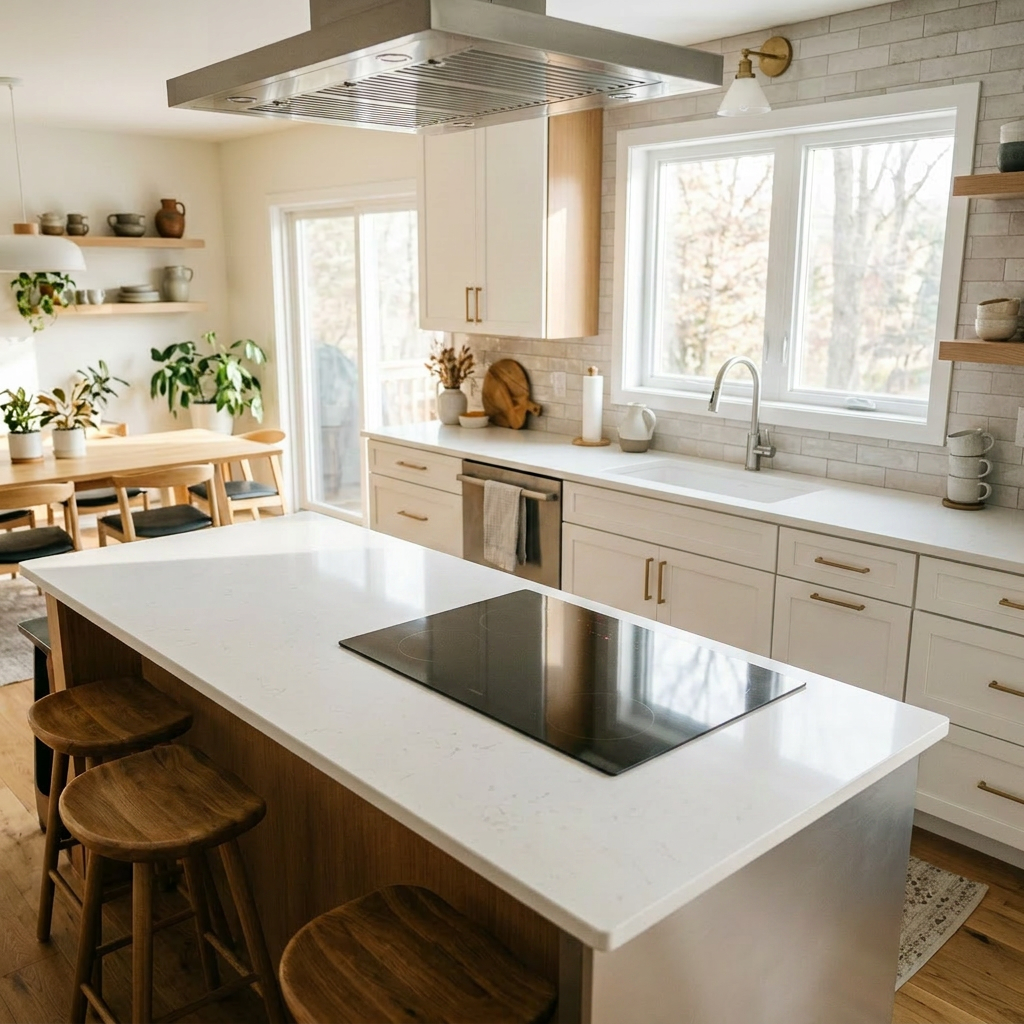
A practical, considered framework for households that actually live in their kitchens
For families of four or more, the kitchen isn’t a design moment — it’s infrastructure.
It’s where mornings start under time pressure, where meals overlap with homework and emails, where appliances run constantly, and where inefficiencies compound fast. A high-functioning kitchen isn’t defined by trends or square footage. It’s defined by how well it supports real life — consistently, quietly, and without friction.
At Matriarch Edit, we define a high-functioning kitchen as one that does three things exceptionally well:
- Absorbs daily chaos without breaking down
- Removes friction from repeat tasks
- Supports the pace of a busy household — not an idealized version of one
Here’s what that actually looks like in practice.
1. Flow Matters More Than Layout
Open concept or closed kitchen. Island or peninsula. These debates miss the point.
A high-functioning kitchen prioritizes flow — how people move through the space at the same time. In family kitchens, peak usage is rarely solitary.
That usually means:
- Clear separation between prep, cooking, and clean-up
- Appliance doors that don’t collide (dishwasher, oven, refrigerator)
- Enough clearance for two people to work simultaneously without friction
If only one person can use the kitchen comfortably, it will fail during real-life hours.
Matriarch principle: Design for concurrent use, not perfect conditions.
2. Appliances Should Reduce Cognitive Load
In busy households, appliances are not aspirational — they are systems.
The most effective kitchen appliances for families prioritize:
- Consistency over customization
- Automation over manual steps
- Low error rates under time pressure
This is why many families find that fully automatic systems outperform prosumer setups in day-to-day use. The goal isn’t control — it’s reliability.
We break this down in detail in Fully Automatic vs. Semi-Automatic Espresso Machines, where ease of use and repeatability consistently win out for households juggling multiple schedules.
If an appliance requires frequent recalibration, precision timing, or constant attention to deliver baseline results, it will eventually go unused.
Related Guide: Best High-Capacity Quiet Dishwashers for Busy Homes
3. Storage Must Be Visible to Be Functional
Most kitchens don’t fail due to lack of storage — they fail because storage is poorly designed.
High-functioning kitchens favor:
- Drawers over deep cabinets
- Pull-outs over fixed shelving
- Eye-level access for daily-use items
Families need to see what they have. When essentials are hidden, time is wasted searching, clutter increases, and duplicate purchases become common.
The best kitchens are honest about what gets used every day — and design storage around that reality.
4. Surfaces Should Prioritize Durability and Cleanup
Family kitchens endure constant wear: spills, heat, scratches, rushed cleanups.
High-functioning kitchens rely on forgiving materials, such as:
- Quartz or sintered stone instead of high-maintenance marble
- Matte or textured finishes over high-gloss
- Integrated backsplashes that wipe clean easily
Perfection adds stress. Durability reduces it.
The same logic applies to cooking surfaces. In Gas vs. Induction Ranges: Which Is Better for Real Family Cooking?, we explore why speed, safety, and cleanup often matter more than tradition in family kitchens.
5. The Kitchen Should Support Daily Routines
Families don’t “use” the kitchen once a day — they cycle through it continuously:
- Morning coffee and breakfast
- Lunch prep or cleanup
- Afternoon snacks
- Dinner production
- Evening reset
A high-functioning kitchen supports these rhythms with:
- Fast-start appliances
- Logical zoning (coffee station separate from cooking zone)
- Easy cleanup pathways
This is why appliances designed for busy households — like those featured in Best Espresso Machines for Busy Households — consistently outperform more complex setups in real-world use.
6. Maintenance Is Part of Functionality
A kitchen is only as good as its ability to stay operational.
For families, that means:
- Appliances with reliable service networks
- Easy-to-replace filters and consumables
- Fewer components that require hand-washing or special care
We address this directly in Espresso Machine Maintenance: What Busy Households Need to Know Before Buying, because maintenance friction is one of the fastest ways a kitchen system breaks down over time.
A truly high-functioning kitchen assumes someone is tired — and designs accordingly.
The Bottom Line
A high-functioning kitchen for a family of four or more isn’t about impressing guests. It’s about supporting the person running the household — day after day, year after year.
At Matriarch Edit, we believe the best kitchens:
- Respect time
- Reduce friction
- And quietly make life easier
That is the standard we use when evaluating every appliance, system, and recommendation we publish.